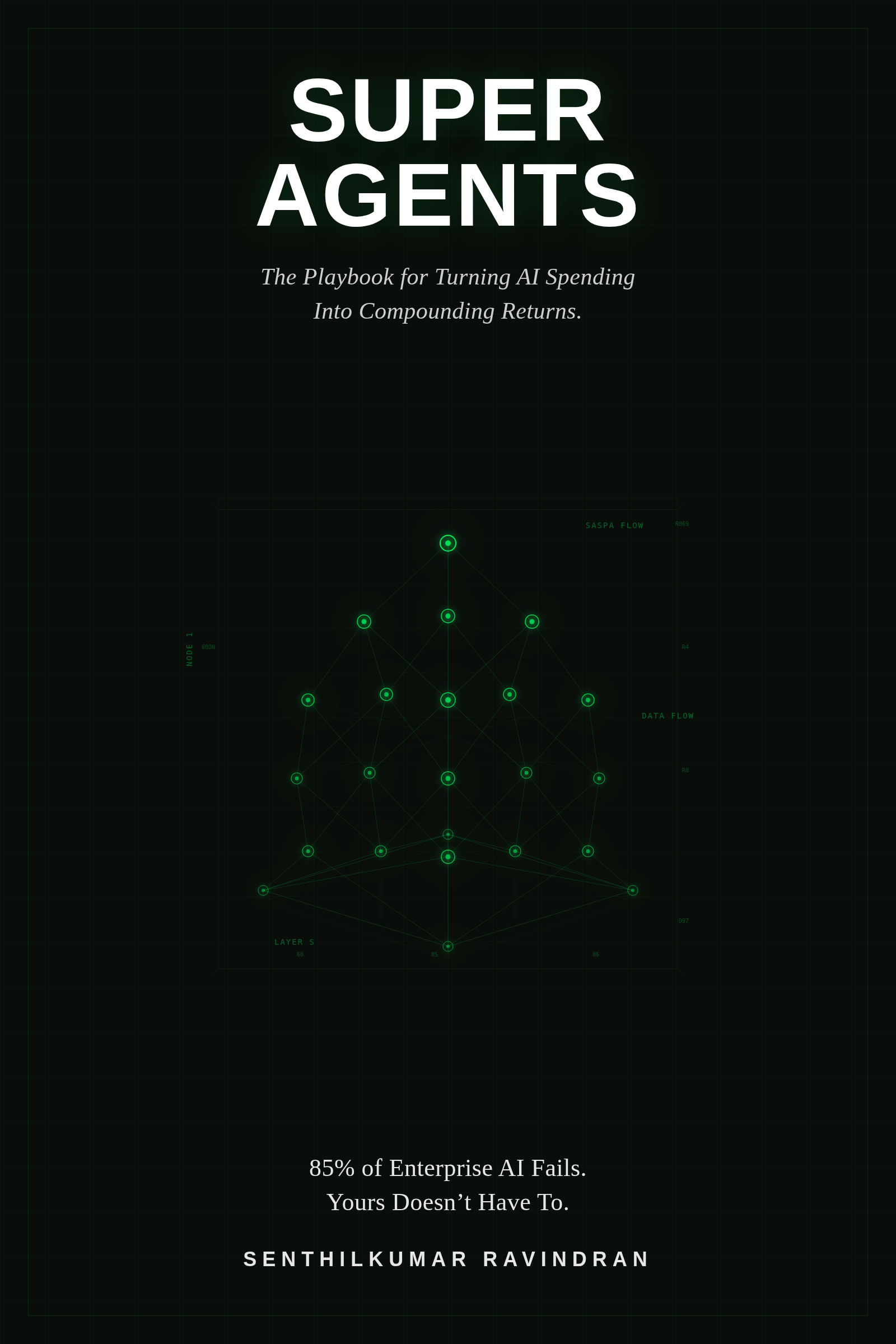
85% of enterprise AI fails.
Yours doesn't have to.
A playbook for building AI that actually works — and keeps working. Four frameworks, nine chapters, one complete system.
“This book is gold. Content rich and thought provoking.”
Chief Architect & Managing Director, Multinational Bank
Most AI promises outpace AI results. Pilots don't reach production. Production systems don't reach value. Budgets grow, returns don't. SuperAgents explains why — and gives you the playbook for doing it differently.
Whether you approve the budget, architect the system, or live with the results, this book is the map you wish you'd had.
- 01 Why Most Enterprise AI Projects Fail
- 02 The Three Eras of Work
- 03 The Human Question
- 04 From Process Architecture to Goal Architecture
- 05 The Safety Architecture
- 06 The Agentic Organisation
- 07 The Value Architecture
- 08 The Implementation Playbook
- 09 The Future of Work 3.0
Includes a preface, concept-to-framework reference appendix, and comprehensive notes.
Your Exposure Profile
An indicative reading of your organisation's structural vulnerabilities, based on the Six Traps framework.
Four frameworks. Each one answers a question every organisation building AI is really asking. Together they form the complete system.
- 1The Automation TrapTreating AI as faster human labour instead of a fundamentally different kind of intelligence. You optimise existing processes instead of reimagining the goal.
- 2The Pilot Purgatory TrapEndless proofs-of-concept that never reach production. Each POC proves the technology works; none prove the organisation can absorb it.
- 3The Data Gravity TrapAssuming more data equals better AI. You invest in lakes and warehouses while the actual bottleneck is goal architecture and feedback loops.
- 4The Black Box TrapDeploying systems nobody can explain, audit, or trust. The resulting governance vacuum kills adoption faster than any technical limitation.
- 5The Vendor Lock-in TrapOutsourcing your AI architecture to a platform vendor whose incentives diverge from yours. Every integration deepens the dependency.
- 6The Metrics Mirage TrapMeasuring what's easy instead of what matters. Accuracy scores and throughput mask the absence of genuine value creation.
- 1Goal OrientationThe system pursues defined outcomes, not prescribed steps. Goals are decomposable, measurable, and aligned with business strategy. A Goal Architect owns the translation layer.
- 2Safety BoundariesHard constraints that limit what the system can do regardless of its goals. Modelled on biological immune systems. Always on, independent of the reasoning layer. Owned by a Safety Designer.
- 3Calibrated AutonomyThe system's freedom to act is proportional to demonstrated competence. Six levels from fully supervised to fully autonomous, with formal escalation criteria at each boundary.
- 4Compound LearningEvery interaction makes the system better. Not just fine-tuning. Structured feedback loops that improve goal decomposition, safety rules, and autonomy calibration simultaneously.
- 0Human Does, AI WatchesAI observes and learns from human decisions. No autonomous action. The system builds its model of the domain.
- 1AI Suggests, Human DecidesAI generates recommendations. Every action requires explicit human approval. The system learns from acceptance and rejection patterns.
- 2AI Decides, Human ApprovesAI selects the action and queues it for human sign-off. The approval is a gate, not a collaboration. The system owns the reasoning.
- 3AI Acts, Human MonitorsAI executes autonomously within defined boundaries. Humans receive reports and can intervene but don't approve individual actions.
- 4AI Acts, Human AuditsAI operates with broad autonomy. Human review is periodic, not real-time. The system self-reports exceptions and edge cases.
- 5Full AutonomyAI manages the complete decision cycle. Human involvement is strategic, not operational. The system adjusts its own goals within board-level constraints.
- 1Direct ValueMeasurable financial impact. Cost reduction, revenue generation, throughput improvement. The dimension traditional ROI captures. Necessary but not sufficient.
- 2Capability LeverageNew capabilities that were impossible before. Not doing the same thing faster. Doing things you couldn't do at all. Market expansion, product categories, service modalities.
- 3Compound LearningThe rate at which the system improves. Organisations with strong compound learning pull away from competitors exponentially, not linearly.
- 4Optionality CreationFuture choices the architecture makes available. A well-designed agentic system creates strategic options that only become visible over time.