A New Book by Senthilkumar Ravindran

Enterprise AI that reaches production,
scales, and compounds in value.

The architectural playbook: four original frameworks, nine chapters, and a complete implementation sequence from diagnosis to deployment.

“This book is gold. Content rich and thought provoking.”

Chief Architect & Managing Director, Multinational Bank
Who this book is for

The literature on artificial intelligence is vast and growing. What remains conspicuously absent is a serious architectural playbook for building AI that works inside large organisations. SuperAgents fills that gap.

It is written for the people who approve the investment, design the system, and bear the consequences when the project is quietly shelved eighteen months later. The book provides not just a diagnosis but a complete framework for building differently.

Technology Leaders
An architecture-first framework for making AI investments compound rather than depreciate. The four-layer Blueprint provides the structural foundation that turns isolated experiments into organisational capability.
Engineering & AI/ML Teams
A formal protocol for graduating AI systems from supervised to autonomous. The Autonomy Spectrum defines six levels with explicit governance criteria at each boundary, eliminating the ambiguity that stalls production deployment.
Strategists & Product Leaders
A measurement framework that replaces vague ROI projections with four dimensions of value: direct financial impact, capability leverage, compound learning rate, and optionality creation. The language your board has been missing.
Founders & Builders
The structural patterns that separate AI products enterprises will adopt from those they will pilot and abandon. Six traps to diagnose, four layers to build on, and a trust architecture that turns technical capability into institutional commitment.
9 chapters across three parts: the diagnosis, the blueprint, and the value capture. A complete architectural playbook from first principles to implementation.
Three books. One architecture.
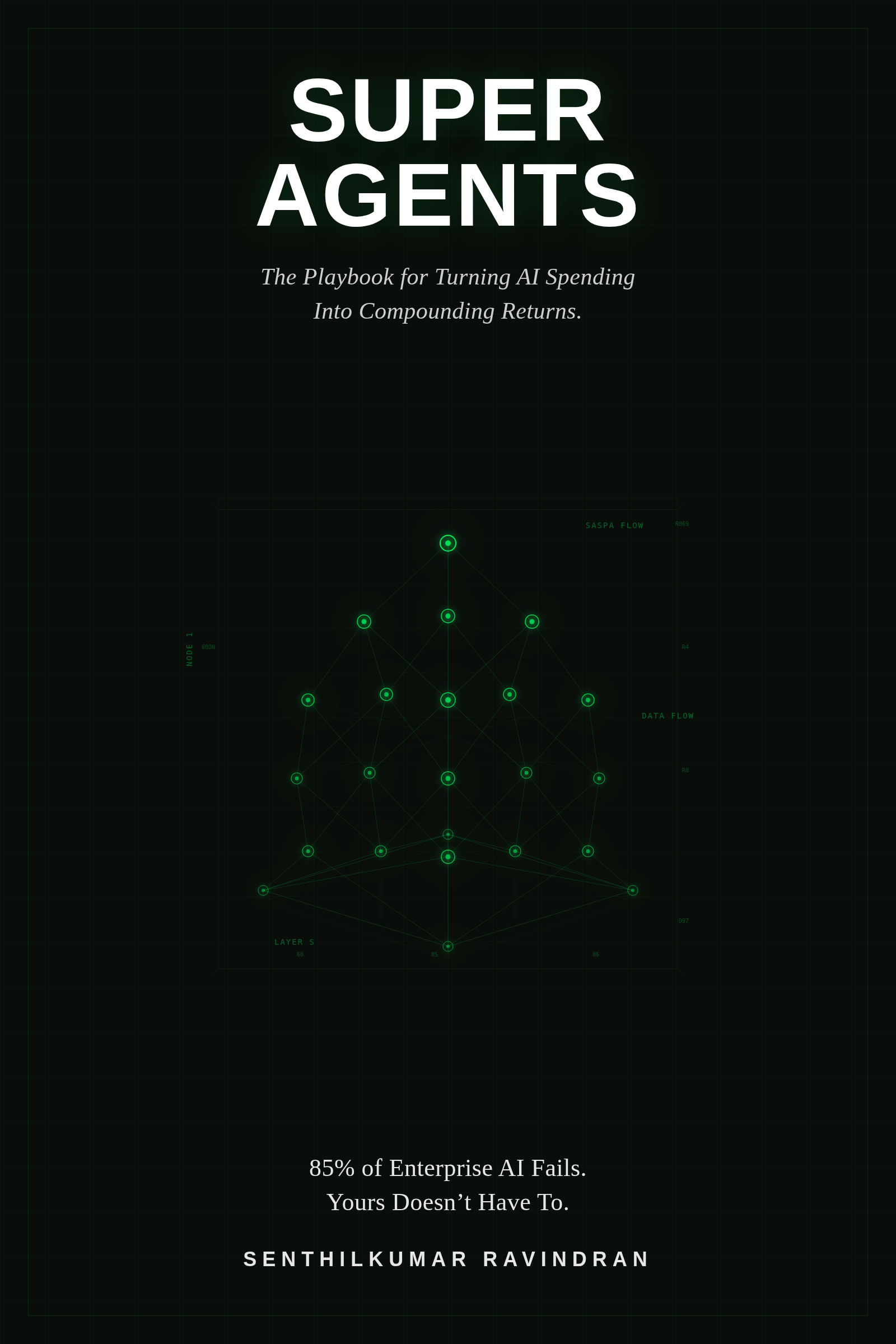
SuperAgents book cover
Available Now
SuperAgents
The architectural playbook for enterprise AI that works. Nine chapters across three parts: the diagnosis, the blueprint, and the value capture.
Forthcoming in the Series
SuperHumans
Roles, skills, and structures for the agentic workforce
SuperProducts
Products that learn, adapt, and compound
The argument in nine chapters
Part 1
The Diagnosis
  • 01 Why Most Enterprise AI Projects Fail
  • 02 The Three Eras of Work
  • 03 The Human Question
Part 2
The Blueprint
  • 04 From Process Architecture to Goal Architecture
  • 05 The Safety Architecture
  • 06 The Agentic Organisation
Part 3
The Value Capture
  • 07 The Value Architecture
  • 08 The Implementation Playbook
  • 09 The Future of Work 3.0

Includes a preface, concept-to-framework reference appendix, and comprehensive notes.

From the Book
The Six Traps Diagnostic
Five questions drawn from the book's opening chapter. An honest assessment of where your organisation stands.
How does your organisation define success for its AI initiatives?
Cost reduction and efficiency metrics
We replicate what competitors are doing
Revenue growth from AI-enabled products
Business outcomes tied to strategic goals with compound learning
When an AI system makes a mistake, what happens?
The team that built it scrambles to patch it manually
We disable it and revert to the human process
The error is logged, but no one reviews the logs systematically
The system flags the error, learns from it, and adjusts its confidence boundaries
How many of your AI systems can explain why they made a specific decision?
None of them. The systems are opaque.
Some have basic logging but nothing actionable
Our vendor says they're explainable
All of them, with calibrated confidence scores and audit trails
A new foundation model emerges that materially outperforms your current stack. What happens?
We're locked into our current vendor for at least 18 months
We start a new POC. Again.
The team gets excited but nothing changes operationally
We swap the model layer and the architecture adapts within days
Who owns your AI strategy?
The CTO. It's a technology initiative.
Nobody specifically. Different teams do different things.
A consulting firm designed our roadmap
A cross-functional team with a Goal Architect, Autonomy Governor, and Safety Designer

Your Exposure Profile

An indicative reading of your organisation's structural vulnerabilities, based on the Six Traps framework.

Four frameworks you can use on Monday

Each framework in the book solves a specific problem you face when building enterprise AI. Diagnose what is going wrong, design the system architecture, calibrate how much autonomy to grant, and measure value beyond simple ROI. They work individually and compound when used together.

The Six Traps
Use this to diagnose why your AI initiatives are stalling. Run the six traps against any current project and you will identify the structural pattern holding it back, not the symptoms, the root cause.
The Blueprint
Use this to design your AI architecture. Four layers: goal orientation, safety boundaries, calibrated autonomy, and compound learning. Each layer has defined roles, governance criteria, and implementation sequences you can follow.
The Autonomy Spectrum
Use this to decide how much freedom to give your AI systems. Six levels from fully supervised to fully autonomous, with explicit criteria for when to promote or demote. Eliminates the guesswork that stalls production deployment.
The Value Balance Sheet
Use this to measure what your AI is actually worth. Four dimensions: direct financial impact, capability leverage, compound learning rate, and optionality creation. Gives your CFO and board a language beyond simple ROI.
Six Traps
Blueprint
Autonomy Spectrum
Value Balance Sheet
  • 1
    The Automation Trap
    Treating AI as faster human labour instead of a fundamentally different kind of intelligence. You optimise existing processes instead of reimagining the goal.
  • 2
    The Pilot Purgatory Trap
    Endless proofs-of-concept that never reach production. Each POC proves the technology works; none prove the organisation can absorb it.
  • 3
    The Data Gravity Trap
    Assuming more data equals better AI. You invest in lakes and warehouses while the actual bottleneck is goal architecture and feedback loops.
  • 4
    The Black Box Trap
    Deploying systems nobody can explain, audit, or trust. The resulting governance vacuum kills adoption faster than any technical limitation.
  • 5
    The Vendor Lock-in Trap
    Outsourcing your AI architecture to a platform vendor whose incentives diverge from yours. Every integration deepens the dependency.
  • 6
    The Metrics Mirage Trap
    Measuring what's easy instead of what matters. Accuracy scores and throughput mask the absence of genuine value creation.
  • 1
    Goal Orientation
    The system pursues defined outcomes, not prescribed steps. Goals are decomposable, measurable, and aligned with business strategy. A Goal Architect owns the translation layer.
  • 2
    Safety Boundaries
    Hard constraints that limit what the system can do regardless of its goals. Modelled on biological immune systems. Always on, independent of the reasoning layer. Owned by a Safety Designer.
  • 3
    Calibrated Autonomy
    The system's freedom to act is proportional to demonstrated competence. Six levels from fully supervised to fully autonomous, with formal escalation criteria at each boundary.
  • 4
    Compound Learning
    Every interaction makes the system better. Not just fine-tuning. Structured feedback loops that improve goal decomposition, safety rules, and autonomy calibration simultaneously.
  • 0
    Human Does, AI Watches
    AI observes and learns from human decisions. No autonomous action. The system builds its model of the domain.
  • 1
    AI Suggests, Human Decides
    AI generates recommendations. Every action requires explicit human approval. The system learns from acceptance and rejection patterns.
  • 2
    AI Decides, Human Approves
    AI selects the action and queues it for human sign-off. The approval is a gate, not a collaboration. The system owns the reasoning.
  • 3
    AI Acts, Human Monitors
    AI executes autonomously within defined boundaries. Humans receive reports and can intervene but don't approve individual actions.
  • 4
    AI Acts, Human Audits
    AI operates with broad autonomy. Human review is periodic, not real-time. The system self-reports exceptions and edge cases.
  • 5
    Full Autonomy
    AI manages the complete decision cycle. Human involvement is strategic, not operational. The system adjusts its own goals within board-level constraints.
  • 1
    Direct Value
    Measurable financial impact. Cost reduction, revenue generation, throughput improvement. The dimension traditional ROI captures. Necessary but not sufficient.
  • 2
    Capability Leverage
    New capabilities that were impossible before. Not doing the same thing faster. Doing things you couldn't do at all. Market expansion, product categories, service modalities.
  • 3
    Compound Learning
    The rate at which the system improves. Organisations with strong compound learning pull away from competitors exponentially, not linearly.
  • 4
    Optionality Creation
    Future choices the architecture makes available. A well-designed agentic system creates strategic options that only become visible over time.

About the Author
Senthilkumar Ravindran

Senthilkumar Ravindran is an inventor, builder, and storyteller who has spent over two decades at the frontier of building exponentially capable products with emerging technology.

His inventive journey started at Tata Consultancy Services, where he was one of the early pioneers working on modernizing mainframes with emerging technology. This foundation led him to Singapore and Citibank's Regional Data Warehouse, where he helped build SalesStation, a revenue intelligence product that presaged today's AI-driven business tools by nearly two decades. In 2014, he founded the Digital Banking Lab at Polaris with a contrarian hypothesis: the future of financial services would converge APIs, AI, and Web3. His team filed six patents starting in 2017, long before enterprise AI went mainstream. Their innovations became APIX, launched by Prime Ministers Modi and Tharman in 2018 as the world's largest financial services innovation marketplace, connecting 200 institutions with 2,000 fintech partners.

When Virtusa acquired Polaris, Senthil scaled DBL's vision into xLabs, bringing together designers and engineers in unprecedented convergence. His team built the Open Innovation Platform, a meta-platform powered by 40 million synthetic customers and 500 million transactions that transformed how banks create products.

In 2023, after a successful corporate career, he took the entrepreneurial plunge, raising seed capital to build an AI firm delivering ontology-grounded agentic systems long before "agentic AI" became a buzzword. Whilst continuing as a Co-Founder in the AI service centric ConceptVines, Senthil is currently focussing on building the next big thing.

He writes from both sides of the AI revolution. As someone who has deployed production systems serving millions, and as a thinker who sees AI as humanity's latest tool for extending intelligence while preserving wisdom. This book is his blueprint for building AI that works.